The Cars, Ultravox, Duran Duran, Blondie, The Human League, and Fleetwood Mac share the spotlight with new songs by Troye Sivan and Leland on one of the most addictive TV soundtracks of the year. And it’s not just nostalgia: the music reveals who the characters in *The Shards* really are.
There are TV series set in the 1980s that seem to evoke that decade.
It seems as though The Shard lives inside her.
From the very start of the first episode—with “Moving in Stereo” by The Cars accompanying a tour of Los Angeles—it’s clear that the music isn’t just there to serve as a backdrop for sports cars, swimming pools, private parties, and impeccably dressed teenagers.
He’s telling the story.
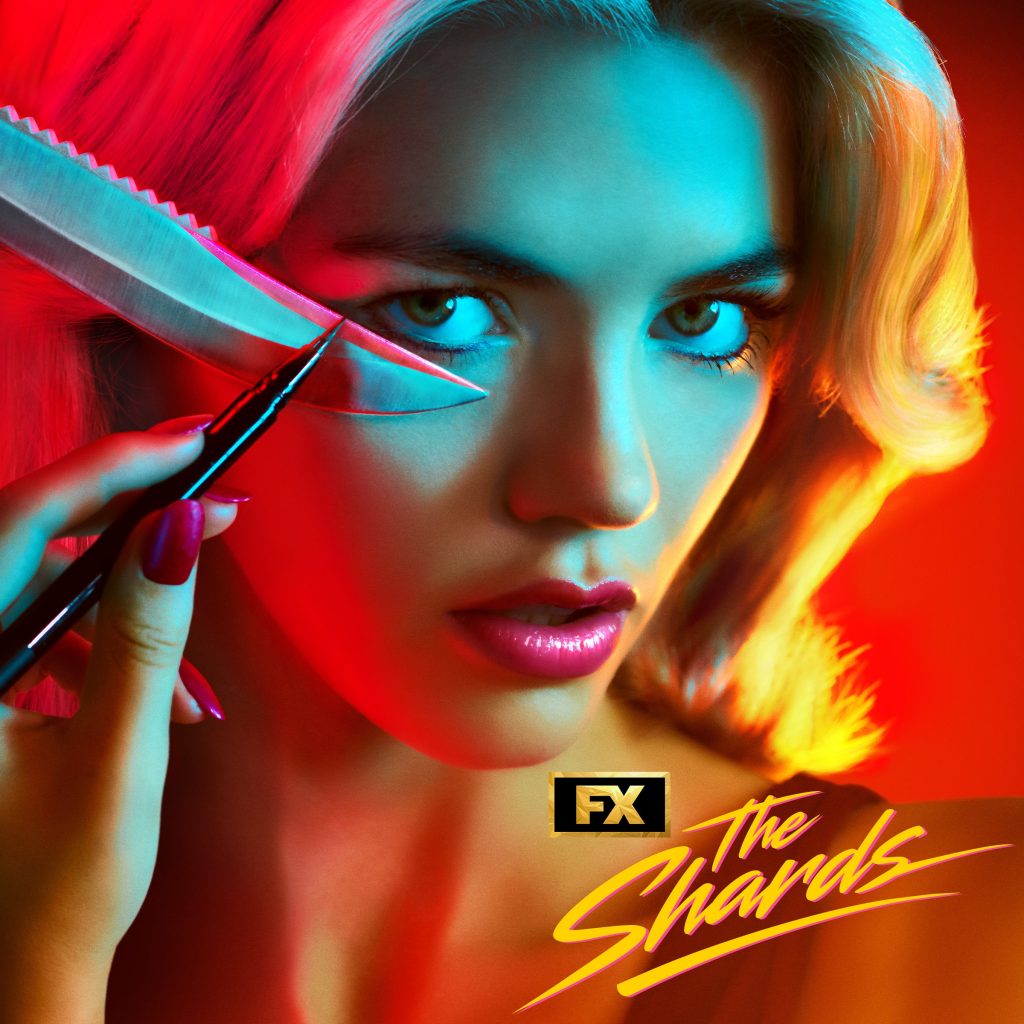
The new FX series, available in Spain via Disney+, is based on the semi-autobiographical novel that Bret Easton Ellis published in 2023 and transports viewers to Los Angeles in 1981, where a young Bret struggles to come to terms with his sexuality, his friendships, and his growing obsession with the mysterious Robert Mallory, while a killer known as “The Trawler” terrorizes the city.
But to truly understand that world, you have to listen to what his characters were listening to.
And that’s where The Shard has the upper hand.
Because few generations have had such a recognizable soundtrack.
Bret Easton Ellis practically wrote the novel while listening to music
The musical connection isn’t something Ryan Murphy came up with.
It lies at the very heart of the book.
Ellis explained that the idea for *The Shards* resurfaced during the 2020 lockdown, when he began searching YouTube for songs from his teenage years in 1980 and 1981. Those videos then led him to search for old high school classmates, and from that mix of music, memories, and nostalgia, the novel he had been trying to write for decades finally came to life.
That helps explain why musical references appear constantly throughout its pages.
In fact, during the adaptation, the production team put together a sort of comprehensive dossier containing all the references to music, film, fashion, and cars found in the book, using it as a guide to accurately recreate 1981.
They weren’t just looking for famous songs from the ’80s.
They were recreating Bret Easton Ellis’s ’80s.
“Moving in Stereo” and a perfect opening track
The series begins with *The Cars*.
And he could hardly do any better.
“Moving in Stereo,” originally released in 1978, opens an episode that immediately transports the viewer to that Los Angeles of the late ’70s and early ’80s: expensive cars, endless highways, huge houses, and a seemingly privileged youth that is beginning to discover that beneath all that beauty lies something rotten.
The song also serves as an aesthetic statement.
Because The Shards isn’t going for the fluorescent colors and giant shoulder pads of the ’80s.
Look for a transitional phase.
Costume designer Lou Eyrich herself explained that the production team preferred a color palette still tied to the late 1970s: grays, muted blues, and mauve tones against which bursts of color could later stand out.
Music does exactly the same thing.
Ultravox, Duran Duran, and the moment when the future began to take shape
Next up is “Vienna” by Ultravox.
Next up : “Planet Earth” by Duran Duran.
And now we’re fully into 1981.
The selection is particularly clever because both songs come from a time when British pop was undergoing a radical transformation.
Synthesizers.
New Romantic.
Video.
Fashion.
Technology.
A world that seemed futuristic even as it was unfolding.
The series uses that music to reflect something essential about its characters: teenagers who are convinced that they are living at the center of the universe and that everything around them—clothes, clubs, drugs, cars, music—exists solely to be consumed.
MTV appears within the story itself
There’s a wonderful detail in the second episode.
The characters enter a club where several screens are showing “Video Killed the Radio Star” by The Buggles.
This is not a random choice.
That video was, in fact, the very first one aired by MTV when the channel began broadcasting on August 1, 1981.
And *The Shards* begins right in the middle of that summer.
The series is literally showing the moment when pop music began to definitively become an audiovisual experience.
For teenagers obsessed with their appearance, desire, and the construction of their identity, that detail is almost too perfect.
Troye Sivan is writing new songs for 1981
And then something even more interesting happens.
Among songs by The Cars, Ultravox, and Duran Duran, there are some that didn’t exist in 1981.
They were written by Troye Sivan and Leland.
But the goal is to make it look as if they could have been there.
Disney confirmed before the premiere that both had composed original music specifically for *The Shards*, deliberately drawing inspiration from the period in which the story is set.
So far, we’ve been able to listen to songs like:
- “Presentation Destination,” featuring Allie X
- “LA Wants Me Dead”
- “Another Day Goes By”
The result is one of the most interesting tracks on the entire soundtrack.
Songs from 2026 weave their way among classics from 45 years ago without necessarily shattering the illusion of time.
Troye Sivan turns out to be a particularly smart choice
Not just because of their music.
Also because of what it stands for.
“The Shards ” largely revolves around a teenager who is trying to understand his desires while in a heterosexual relationship and hiding a fundamental part of his identity.
Troye Sivan belongs to a completely different generation, but his work has been exploring queer desire, intimacy, sexuality, and the construction of identity for years.
Having his voice appear within the world of the teenage Bret builds an invisible bridge between two eras.
The young man who, in 1981, could not openly express certain emotions now listens to music created four decades later by someone capable of putting those emotions into words.
That connection may be one of the most subtle elements of the series.
Hayes Warner lives both within and outside the soundtrack
There is another case that is even more curious.
Hayes Warner plays Debbie Schaffer, Bret’s girlfriend on the show.
But Warner was already a singer before becoming an actress, and she has also written original music for *The Shards*. Disney introduced her as part of the team of artists responsible for new songs for the project, and she herself has since explained that some of them were composed from Debbie’s perspective.
That makes music more than just background music.
The actress uses songs to continue developing a character she is already portraying on camera.
In a way, Debbie now has songs of her own.
The original soundtrack also tells another story
Behind all those needle drops, there is also an original score composed by David Klotz and Morgan Kibby.
Its function is almost the opposite.
While the folk songs place the characters in a specific cultural moment, the score introduces fear, sensuality, paranoia, and danger.
Cast member Jordan Roth has explained it particularly well: the series features three distinct musical elements—Bret’s narration, songs from the era, and the original score—that come together to create a unique emotional texture.
That explains why The Shards can shift in a matter of seconds from the hedonistic pleasure of a pop song to the feeling that someone is watching from the shadows.
The songs from the first episode
The first hour already feels practically like an extraordinary early-’80s mixtape:
The Cars – “Moving in Stereo”
Ultravox – “Vienna”
Troye Sivan & Leland feat. Allie X – “Presentation Destination”
Duran Duran – “Planet Earth”
The Go-Go’s – “This Town”
The Stranglers – “Golden Brown”
Joan Jett & The Blackhearts – “Crimson and Clover”
The Pretenders – “Bad Boys Get Spanked”
Troye Sivan & Leland – “LA Wants Me Dead”
It would be hard to ask for a clearer statement of intent.
And the second episode certainly doesn’t fall short
The selection continues with:
Herb Alpert – “Rise”
Troye Sivan & Leland – “Another Day Goes By”
The Human League – “Don’t You Want Me”
Dionne Warwick – “Déjà Vu”
The Buggles – “Video Killed the Radio Star”
Fleetwood Mac – “Tusk”
Al Stewart – “Year of the Cat”
In just two episodes, the soundtrack spans new wave, synth-pop, rock, jazz-pop, punk, and disco.
And the list keeps growing week after week.
Blondie, Dire Straits, U2, and Peter Gabriel also feature in the show’s universe
The official playlist for *The Shards* is expanding with the release of new episodes.
The included songs also feature artists such as Blondie, Dire Straits, The Clash, U2, Peter Gabriel, DEVO, The Specials, Joan Armatrading, and Stevie Nicks, confirming that the project aims to capture a musical era, not simply compile a collection of hits.
The official FX playlist currently features dozens of songs, and its evolution has almost become a parallel narrative to the series itself.
The “Shards ” effect is already being felt on Spotify
Here is one of the most interesting facts.
After the premiere, searches for The Shards’ official playlist on Spotify increased by 5,400%.
Not only that.
The audiobook version of the novel saw its global listenership increase by approximately 1,100%, while searches for the title rose by about 900%.
In other words: the series isn’t just using old music.
He’s drawing the audience back to that music.
Exactly the phenomenon we saw with Kate Bush after *Stranger Things* or with Fleetwood Mac following certain viral hits.
It’s still too early to tell which song will come out on top.
But the machinery is already up and running.
Bret Easton Ellis has always written as if a song were playing
Perhaps none of this should come as a surprise.
The titles of two of his best-known novels are taken from Elvis Costello songs: *Less Than Zero * and *Imperial Bedrooms*.
Music runs through virtually all of his work.
Ellis has explained on several occasions that he responds to music in a deeply emotional, rather than intellectual, way, and that few things have influenced him as much.
That’s why his characters always seem to be listening to something.
A song in the car.
A radio station.
A cassette.
A club.
Music serves as a calendar, but also as a psychological state.
Ryan Murphy understood that part of the book perfectly
Murphy could have used big hits from the ’80s and relied on the nostalgia factor.
He didn’t do it exactly that way.
The selection serves a narrative purpose.
The songs help us understand the emotional detachment of teenagers who seemingly have it all: money, beauty, cars, huge houses, and virtually unlimited access to any pleasure.
Meanwhile, someone is murdering young people in the same city.
That contrast between irresistible songs and escalating violence is quintessentially Ellis.
The music sounds great.
The world he describes—not so much.
A soundtrack about the moment just before everything changed
1981 is also an extraordinary year for setting a TV series in a musical context.
Punk hasn’t completely disappeared yet.
New wave is taking off.
Synth-pop is starting to take over.
MTV has just been launched.
The music video is about to change the way stars are made.
And pop music began to evolve into the massive audiovisual industry that would dominate the rest of the decade.
The characters in *The Shards* don’t know anything about that yet.
We do.
And that awareness turns every song into a little time capsule.
Perhaps the real star of *The Shards* is its playlist
Ryan Murphy creates beautiful characters.
Bret Easton Ellis’s work features obsession, sex, paranoia, and violence.
Disney has a massive production output.
But after several episodes, there’s something that lingers even after we turn off the screen.
The songs.
“Moving in Stereo.”
“Vienna.”
“Planet Earth.”
“Don’t You Want Me.”
“Video Killed the Radio Star.”
“Tusk.”
And Troye Sivan’s new songs, hidden among them like artifacts from the future.
” The Shards ” may tell the story of a teenager trying to remember who he was in 1981.
But its soundtrack does something even more powerful.
It allows us to remember what that world sounded like.