For more than a decade, the Peaky Blinders universe has shown that music can be much more than a simple narrative accompaniment. In this story of crime, ambition and power set in early 20th century England, sound has always been a fundamental part of the saga’s identity.
With the final leap to cinema in Peaky Blinders: The Immortal Man, this relationship between image and music becomes even more ambitious.
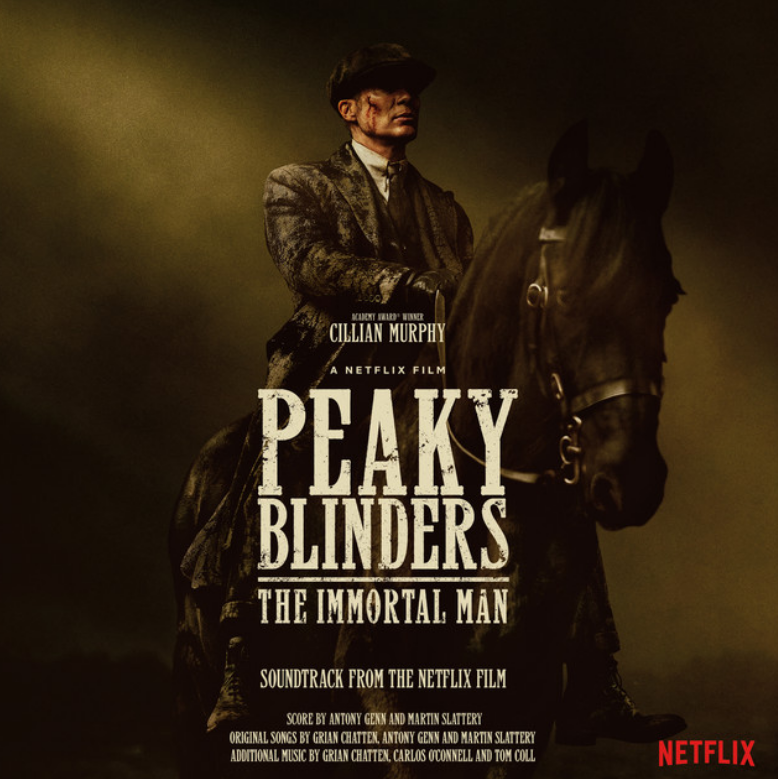
The new film is accompanied by a 36-track soundtrack that mixes cinematic score, original compositions and reinterpretations of key songs within the imaginary of the series. The project is musically directed by composers Antony Genn and Martin Slattery, who have opted for a raw, visceral and deeply human sound approach.
Instead of the grandiloquence typical of blockbusters, the film’s music seeks to convey texture, tension and a constant sense of danger.
The inevitable return of “Red Right Hand
Since the first episode of the series, one song has defined the tone of Peaky Blinders: “Red Right Hand” by Nick Cave.
The track became a sonic symbol of Tommy Shelby’s story and the dark atmosphere surrounding the Birmingham crime family. Its blend of gothic blues, rock and narrative tension fit perfectly with the visual aesthetic of the series.
In The Immortal Man, the song returns with a new, more cinematic reinterpretation. The version maintains the haunting character of the original, but adds an orchestral dimension that amplifies its dramatic weight within the feature.
More than a nod to the past, its presence functions as a reminder: the Peaky Blinders universe is still dominated by the shadow.
Fontaines D.C. and the new generation of the Peaky Blinders sound.
One of the most interesting elements of the soundtrack is the strong presence of members of Fontaines D.C..
The Irish group has established itself in recent years as one of the most influential bands in contemporary post-punk, and its aesthetic fits surprisingly well with the rough and melancholic world of Peaky Blinders.
Its vocalist, Grian Chatten, participates in several original pieces within the soundtrack, including the song “Puppet”. In addition, he also contributes a reinterpretation of the trip-hop classic “Angel” by Massive Attack.
Other members of the group -such as guitarist Carlos O’Connell and drummer Tom Coll- also participate as performers at different points in the album.
The result reinforces the saga’s sonic identity: dense guitars, intense vocals and a constant sense of emotional tension.
Punk, dark folk and rebellious spirit
The soundtrack is not limited to contemporary alternative rock.
The project brings together artists from different musical scenes who share a common sensibility: intensity, rawness and a certain emotional darkness.
Among the collaborations is the presence of Amy Taylor, lead singer of Amyl and the Sniffers, who performs the original song “Nobody’s Son”, bringing a direct and explosive punk energy to the soundtrack.
Also appearing is the Irish group Lankum, whose dark folk approach fits the tragic and fatalistic atmosphere that has always surrounded the Shelby family story.
This mix of styles creates a sound map that combines rock, folk and electronica with the cinematic tension of the Peaky Blinders universe.
The Peaky Blinders Universe’s leap to the movies
Peaky Blinders: The Immortal Man marks the first film adaptation of the television phenomenon created by Steven Knight.
The film reprises Cillian Murphy in the role of Tommy Shelby, leader of the criminal clan that dominated the streets of Birmingham after the First World War.
In this new stage of the story, the plot shifts to the context of World War II, broadening the scope of the story and exploring new threats to the Shelby family.
The cast also includes Barry Keoghan, Tim Roth and Stephen Graham.
The film hits UK cinemas first ahead of its global release on Netflix, marking a new era for one of the most influential TV franchises of recent years.
Music as the DNA of the saga
Since its first season, Peaky Blinders has used contemporary music to reinterpret the past.
Instead of resorting exclusively to historical compositions, the series has always preferred to connect its narrative with modern sounds: alternative rock, dark blues, electronic or post-punk.
That decision helped build a unique aesthetic identity that turned the series into a cultural phenomenon.
With The Immortal Man, that philosophy continues.
The soundtrack doesn’t try to sound like a historical film. It prefers to capture the same rebellious, dangerous and emotional energy that defined the series from the beginning.
A mix of raw guitars, spectral vocals and dense atmospheres that continue to accompany Tommy Shelby’s inevitable destiny.