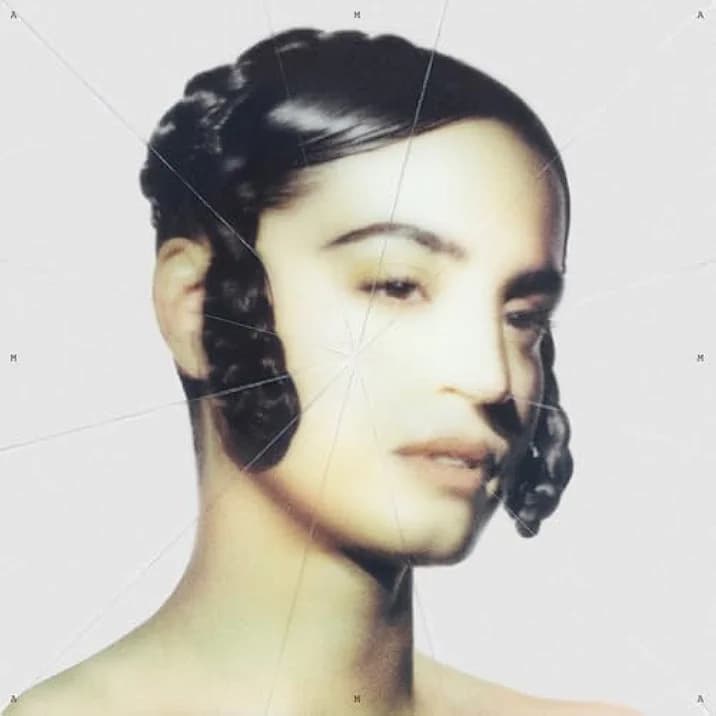
Maria Arnal signs the most ambitious and revealing work of her career. AMA, released on February 20th through Atlantic Records, is not only her first solo album: it is the work where everything she had built up to now makes sense and expands into a new sonic and conceptual language.
After years of redefining contemporary folklore and exploring the limits of the voice with Marcel Bagés, the Catalan artist arrives at a territory of her own where tradition, advanced electronics and technological research coexist without hierarchies. Here there is no rupture, there is culmination.
A title that is origin, affirmation and mandate
AMA works as a manifesto from its own word. It is verb and it is identity. It is the imperative to love, but also the affirmation of authorship: the artist who takes total control of her story.
Phonetically, the open “A” and the primary “M” refer to the maternal, to the beginning of language, to the first articulation of the human voice. From that zero point the album is born: a personal and sonorous reconstruction that turns the voice into a physical, emotional and political axis.
Thirteen songs where the voice is multiplied
The album, produced with Alizzz and Pau Riutort, expands the universe already anticipated by the singles Ama, Pellizco and Que me quiten.
But here everything takes on another dimension:
- Traditional polyphony coexists with synthetic choirs
- Electronics opens up to a clear pop ambition
- The voice is split between human and digital
And in this dialogue appears one of the major themes of the album: the violence that has historically crossed the body and the experience of women. Not from the discourse, but from repetition, texture and emotion.
Every vocal layer is memory. Every loop is resistance.
Artificial intelligence as an emotional tool
Far from the superficial use of technology, Arnal has spent years researching the relationship between voice and machine.
The AMA process includes:
- Stage work with Marcos Morau
- The soundtrack of Polvo will be
- The Maria Choir facility
- Research with the Barcelona Supercomputing Center
- The Intelligent Instruments Lab in Reykjavik
AI does not replace voice: it accompanies it.
Breath, error and imperfection remain at the center. Technology becomes a mirror that amplifies the human.
An album that sounds like an arrival
What makes AMA great is that it doesn’t sound like a transition.
Sounds like:
- Consolidated identity
- Proprietary language
- Artistic maturity
Maria Arnal is not testing roads. She is living her own.
And in this territory, oral tradition, experimental pop and sound research coexist with a naturalness that very few European artists have achieved in the last decade.
The most solid moment of his career
This album comes after three years of creative expansion in which the artist has taken her voice into the realm of performance, contemporary composition and sound installation.
The result is a work that:
- dialogues with the present
- questions the structures of power
- and redefines the role of technology in music
All without losing emotion.
Because if there is something that runs through AMA, it is the sensation of body. Of presence. Of truth.