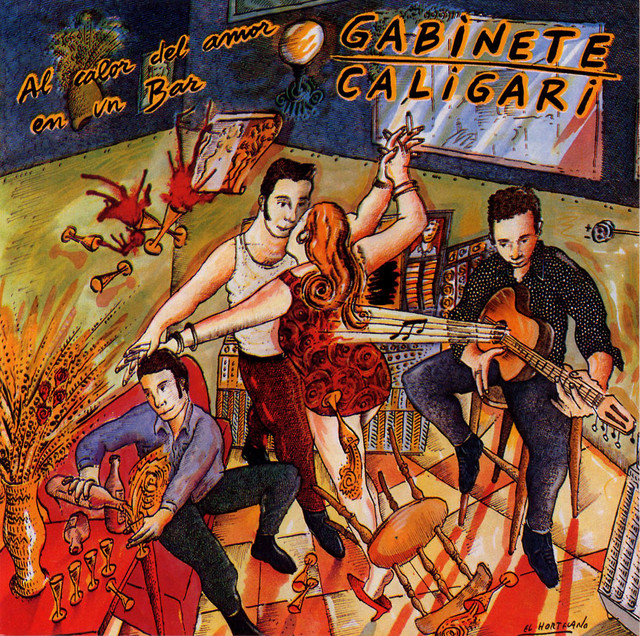
Warner reissues on red vinyl ‘Al calor del amor en un bar’, the album that turned the castizo culture into one of the great symbols of Spanish pop.
There are important records.
And then there are those records that end up functioning as an emotional snapshot of an entire city.
Gabinete Caligari did exactly that with Al calor del amor en un bar.
Because beyond the songs…
the album managed to capture an idea of Madrid that is still alive forty years later:
👉 crowded bars
👉 napkins on the floor
👉 smoke
👉 early morning
👉 modern chulapos
👉 and that impossible mix between rock and traditional Spanish tradition that nobody had been able to turn into pop until then.
Now, four decades after its original release, Warner Music Spain is reissuing the album on new red vinyl to coincide with May 15, San Isidro.
And honestly…
there is something very poetic about this album coming back just now.
🍷 The record that turned the bars into the emotional heritage of Spanish pop

Few songs have summed up the emotional identity of a city as well as:
👉 “Bars, what places…”
Because Al calor del amor en un bar was not just a hit.
It was almost Madrilenian sociology sung.
While much of Spanish pop music in the 80s was obsessively looking towards London or New York…
Gabinete Caligari decided to look towards:
- neighborhood bars
- the chotis
- castanets
- the bulls
- spanish popular culture
And that completely changed the rules.
🖤 Gabinete Caligari did something that today would seem impossible
At the height of the Movida Madrileña explosion – dominated by Anglo-Saxon references – Gabinete opted for something extremely risky:
👉 sound Spanish.
Very Spanish.
And that included using:
- castanets
- bullfighting references
- traditional imaginary
- madrilenian popular language
All within rock songs.
Today it seems natural.
But in 1985 it was almost a cultural provocation.
And probably therein lies a good part of the greatness of the group.
🎸 “In the heat of love in a bar” still sounds strangely modern.

Listening to the album today is still surprising.
Not only for nostalgia.
But because many songs retain a huge personality.
Especially:
- In the heat of love in a bar
- Damn proverbs
- Song of the colt
- The game and the toy
The production of Jesús N. Gómez helped a lot to build that balance between:
👉 classic rock
👉 Spanish pop
👉 popular tradition
👉 and urban modernity.
And then there is the cover by El Hortelano and the photographs by Alberto García-Alix, which ended up turning the album into a cultural object much bigger than the music itself.
🌆 Gabinete Caligari’s Madrid no longer exists… but we are still looking for it.


Maybe that’s why this anniversary connects so much.
Because the Madrid portrayed by Gabinete Caligari:
- dirtier
- more nocturnal
- more humane
- more unpredictable
seems almost mythological today.
And at a time when many cities are losing their cultural identity in the face of globalization?
going back to this album feels almost like opening an emotional time capsule.
🎤 The influence of Gabinete continues to appear in current artists.
Many later Spanish musicians understood thanks to Gabinete Caligari that:
It was not necessary to copy the Anglo-Saxon to sound contemporary.
Bands and artists of later generations -from Bunbury to Calamaro or even part of modern Spanish indie- inherited that idea:
to make rock from their own cultural references.
And that turned Gabinete into much more than an 80’s band.
It turned them into a cultural reference.
💿 New red vinyl makes the record a collector’s item
The reissue on red vinyl also comes in the midst of the return of the physical format.
And honestly…
these kinds of albums make a lot more sense on vinyl than on streaming.
Because Al calor del amor en un bar belongs to a time when listening to records was still a thing:
- ritual
- time
- object
- physical memory.
🎯 The recommendation of LoffMusic
There are records that get old.
And others that end up defining a complete cultural identity.
Al calor del amor en un bar clearly belongs to the second group.
From LoffMusic, our recommendation is clear: if you have never listened to this album in its entirety, do it now because you will probably understand Madrid, Spanish pop and much of our popular culture better after doing so.