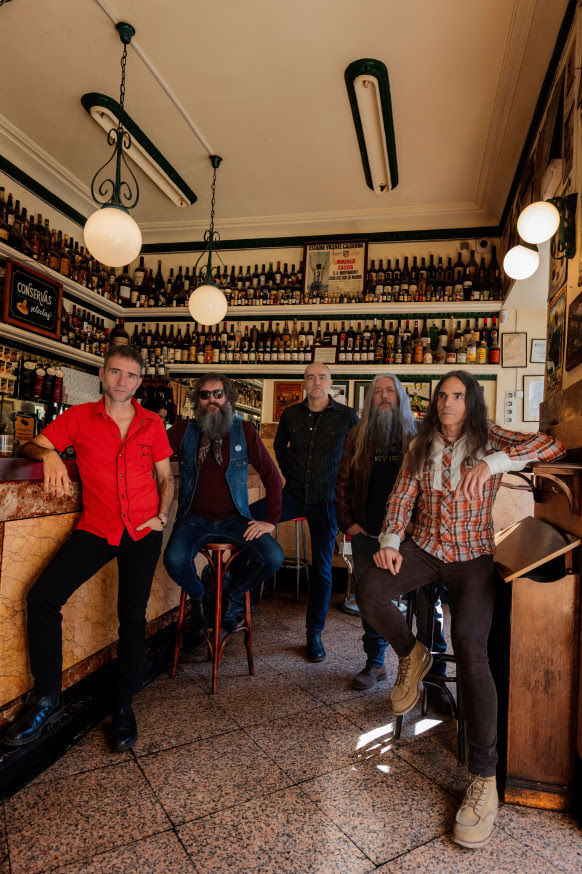
The collaboration between Los Coronas and Arizona Baby presents “Caramelo envenenado,” the latest single from Órdago. Fifteen years after that experiment—which was supposed to last just a few concerts—Corizonas seems to have found its best form by blending American guitars, Spanish roots, and songs in Spanish.
Some groups are formed after months of planning.
Corizonas was born because nobody wanted to go home.
At the beginning of the last decade, Los Coronas and Arizona Baby decided to share the stage under the name Dos Bandas y un Destino. The original idea was quite simple: to go on a joint tour, play songs by both bands, and have fun covering some of their favorite classics.
There must have been ten or fifteen concerts.
But something happened.
The two bands discovered that together they could become a third band.
Fifteen years later, that adventure continues.
And now it has the perfect name:
Órdago.
“Poisoned Candy” or Sweet Until It’s Not Anymore
The latest single from the new album is called “Caramelo envenenado.”
And the title pretty much sums up the song.
Corizonas returns to that borderland that has always been part of its DNA: guitars that sound as if they’ve crossed the desert, hypnotic rhythms, American rock, and an unmistakably Hispanic flavor.
But this time, everything is designed to be mobile.
To dance.
To let yourself go.
Until the poison appears.
“The more you suck, the less you live. If you don’t spit it out, you’ll die.”
The tagline accompanying the launch sums up that duality.
Something irresistible that could end up hurting you.
A piece of candy.
And a word of caution.
Corizonas was never just Los Coronas + Arizona Baby
That might be the first thing to explain to anyone who’s just joined the group.
Since the early 1990s, Los Coronas had been exploring instrumental surf music, spaghetti westerns, and border rock, with Dick Dale, Link Wray, and The Ventures among the influences that helped shape their sound.
Arizona Baby, for their part, emerged from Valladolid with a surprisingly stripped-down acoustic sound and a style rooted in American folk and rock. In 2010, they performed more than a hundred concerts and shared the stage with artists such as Mark Knopfler and Chris Isaak.
When the two worlds collided, something unexpected happened.
It worked.
and make sure there are plenty of them
In 2011, *The News Today*.
Corizonas already existed.
Fifteen Years Searching for a Place Between Two Continents
That first album had its roots firmly planted on the other side of the Atlantic.
Country.
Folk.
Surfing.
Soul.
Rock and roll.
Border Music.
The band members themselves described their sound at the time as a blend in which roughly half came from American roots music and the other half from rock and roll
But Corizonas didn’t stop there.
In New Vital Dimension, published in 2016, something fundamental happened:
Spanish came to the forefront.
The band retained its American DNA but began to look much more toward home, incorporating new elements and expanding a musical style that already included rock, psychedelia, and pop.
A decade later, Órdago seems to be taking that evolution to its logical conclusion.
And then Corizonas covered C. Tangana
The first major clue about the new season came in November 2025.
And it was quite unexpected.
Corizonas decided to take on “Tú me dejaste de querer, ” one of the key songs from C. Tangana’s *El Madrileño *.
But trying to reproduce the original would have made little sense.
So they did exactly the opposite.
They took him to their world.
Subterfuge described that transformation as “rumba-rock-yeyé,” placing it somewhere strange between Los Brincos, Triana, and Los Planetas.
The election was much more revealing than it seemed.
A band that for years had been traveling in its imagination to the United States was taking one of Spain’s recent big hits and sending it in the opposite direction.
The Americas were no longer the destination. They were just a part of the journey.
“Beginning and End”: Starting Over
The next chapter was released on March 12, 2026, with “Beginning and End.”
Javier Vielba wrote a song based on a very simple idea:
start over.
Musically, their sound drew on British pop, the American West Coast, and some of the great Spanish pop of the 1960s. Even the band itself acknowledged a certain Beatles-esque spirit and echoes of Los Brincos.
The song was produced by Javier Vielba and Javier Vacas, reinforcing the sense that Corizonas had definitively ceased to function as the sum of two projects.
It doesn’t really matter anymore where Arizona Baby ends and Los Coronas begin.
It sounds like Corizonas.
“Una y Otra Vez” and When Radio Futura Meets Leiva
And then came what is possibly the most accessible song of this new phase.
“Again and Again.”
Radio 3 introduced it in May as a fusion of Radio Futura and Leiva, infused with a vibrant pop-rock sound in the Anglo-Saxon tradition.
It’s an interesting comparison.
Because it perfectly captures the direction Corizonas is taking.
The band, which started out drawing inspiration from American rock, is now capable of writing a song that simultaneously evokes one of the most influential bands in Spanish pop and one of its most popular contemporary songwriters.
But behind the melody lay something less bright.
Defeat.
Persistence.
The feeling of watching others take your place.
And the decision to lift the stone again.
Over and over again.
Subterfuge described it as a song about resilience and persistence, featuring a sort of “electric Sisyphus.”
There’s probably some autobiographical element to it as well.
Because Corizonas has been surviving Corizonas for fifteen years
There is something fascinating about this band.
The band members never stopped pursuing other musical endeavors.
Arizona Baby.
Los Coronas.
Sex Museum.
The Enemies.
The Meister.
Other albums.
Other tours.
Other scenarios.
Javi Vacas explained in 2021 that it was precisely this overlap between projects that was one of the reasons why Corizonas’ albums could take years to come out.
Maybe that’s why every homecoming feels a bit like a family reunion.
There is no industry-wide requirement to release an album every two years.
Corizonas appears when it makes sense for Corizonas to appear.
And in 2026, it seems to have it.
Now comes “Poisoned Candy”
After “Tú me dejaste de querer,” “Principio y Final,” and “Una y Otra Vez,” “Caramelo envenenado” is the final track before the release of Órdago.
And it’s probably also the one that best sums up the trip.
There’s rock music.
There are roots.
There are frontier guitars.
But there is also something that is difficult to pinpoint geographically.
A kind of imaginary folk music set somewhere between Madrid, Valladolid, California, Mexico, and any highway connecting all those places.
She’s not exactly American.
Nor is it exclusively Spanish.
It’s a transatlantic flight.
And that word might describe Corizonas better than any genre label.
Cinema remains hidden within his songs
There is another factor that helps us understand their sound.
Corizonas has always had a particularly strong connection to the movies.
Javier Vielba has cited David Lynch, John Waters, Sergio Leone, Ennio Morricone, Jim Jarmusch, Quentin Tarantino, Berlanga, José Luis Cuerda, and Mario Camus among his influences.
It’s not hard to hear him.
Many of Corizonas’ songs seem tailor-made to accompany a movie that doesn’t exist yet.
Roads.
Deserts.
Defeated characters.
Cafeterias.
Cities.
Losers who keep moving forward.
And now, a piece of candy that could kill you if you don’t know when to spit it out.
Why “Órdago”?
Even the album title is significant.
An ” órdago ” isn’t just a bet.
It means going all in.
The word comes from “mus” and conveys a fairly recognizable attitude: stop calculating and lay everything out on the table.
It’s hard to imagine a more fitting title for a band made up of musicians who have been playing rock for decades, at a time when rock has long since ceased to be the focus of popular conversation.
Corizonas doesn’t seem interested in sticking with what works.
As early as 2016, Fernando Pardo was advocating precisely for the possibility of breaking free from what was supposed to work.
Ten years later, they’re still doing it.
“Órdago ” arrives on September 18
Corizonas’ fourth album will finally be released on September 18 via Subterfuge Records, according to the latest information provided by the label.
The day before, on September 17, the band will be performing at Canopy Madrid.
And on November 27, it will be Seville’s turn, with a concert at Sala Malandar.
It will be time to see how all the pieces fit together.
Because these four previews already tell a rather curious story.
C. Tangana reimagined as traditional rock.
A song about starting over.
Another one about falling down and getting back up.
And finally, a piece of candy that tastes too good to be harmless.
Corizonas found its place by stopping looking for it
Perhaps that is the story that truly leads to *Órdago*.
In 2012, just a few months after they had officially become Corizonas, Fernando Pardo said something that now seems almost prophetic.
The challenge, he explained, hadn’t been finding a style but rather writing good songs.
Fifteen years later, it seems they are still following that rule.
Los Coronas brought the surf, the reverb, and the desert dust.
Arizona Baby brought songs, vocals, and folk music.
Spain ended up entering through a door that initially seemed to face toward the Americas.
And over time, everything got mixed up until it became impossible to know exactly where each thing came from.
That’s probably Órdago.
Don’t choose between here and there.
Go all in.
And wait to see which card lands on the table.