On January 23rd, Por la Hierba arrived, the fourth studio album by Ángel Stanich and, probably, the bravest, most naked and complete of his entire discography. A work that shows a taciturn and confessional Stanich, but without giving up that domestic and literary surrealism that has made him a unique figure in the Spanish alternative rock.
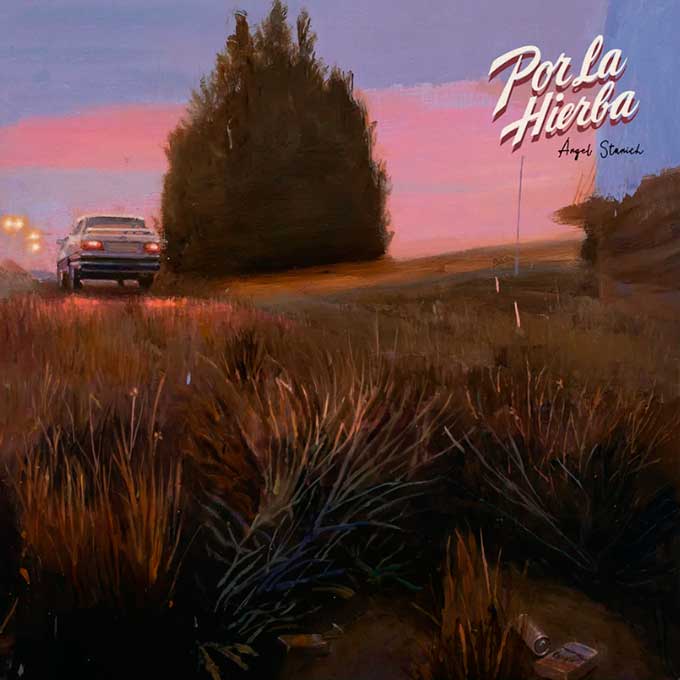
From the first glance, the cover illustrated by Íñigo Sesma sets the tone: nocturnal, secondary road, twilight cinema and a sense of forced pause. Por la Hierba is not an album for running; it is an album that forces you to stop, to listen between the lines and to accept the trembling.
An emotional “Nebraska” after anxiety
Defined by many as Stanich’s own Nebraska, the album is born after a real episode of anxiety that pushes the author to look inward without filters. The result is eight poems of introspection and an unexpected song, wrapped in electronic cellophane, unpredictable arrangements and a crystalline production signed by Stanich himself together with Juan Torán.
Here coexist biographical and social disenchantment, camouflaged confessions and a new naturalness in language. Everything sounds closer, more human… and, even so, absolutely Stanichian: capable of linking the fluttering of a hummingbird with the making of mayonnaise without a fuss.
Emotional shooters between synth-pop, blues and bachata
Musically, Por la Hierba is a clear leap from previous works. The album progresses from a more electronic beginning -in digital and CD- to a deeply moving closing with the homonymous song, which opens the vinyl edition as a metaphor of the vital detour, wrapped by synthesizers that seem to breathe.
Among the key moments of the album, the following stand out:
- “I bring you love,” a radioactive lullaby that marked his return.
- “Poquita fe”, a danceable bomb of futuristic remember and motorik kraut.
- “Carretera o trueno”, a 7 and a half minute synth-pop epic with echoes of Robert Palmer’s Johnny and Mary, cameos by Abraham Boba and the final voice of Anni B Sweet, turned cosmic femme fatale.
- “Una bachata nueva”, a tribute as unexpected as it is legitimate to the Dominican genre, with bongos and güira by Latin Grammy winner Johnny Gómez, and a wink so in tune that even Juan Luis Guerra might feel alluded to.
- “Alone in the City”, a rock ballad in Springsteen / The War On Drugs key, crossed by a nocturnal saxophone that turns urban anxiety into a luminous postcard.
Pop culture, cinema and references that beg to be reread
As usual, Por la Hierba is not exhausted on the first listen. Its constant subcultural references work as a second hidden album: from Lorca to Lamine Yamal, from Burning to Violeta Parra, from Radio Futura to Triana, from the A-2 to Teruel, El Sobón or Legazpi.
Cinema has a special weight here: Thelma & Louise, Mulholland Drive, Fight Club, Carlito’s Way, Poltergeist or Truffaut appear as narrative echoes that reinforce the feeling of an interior road movie, of slow escape and forced reflection.
An album that immerses you… and brings you back different…
Por la Hierba is an album that soaks. It does not seek immediate hymns or generational slogans, but something more difficult: to accompany. Its emotional power is progressive, almost therapeutic. It sinks you gently and brings you back to the surface with another perspective.
Ángel Stanich signs here a more realistic, more musical and deeper work, which confirms his artistic maturity without losing the mystery. An album that does not fully explain itself – nor does it want to – and that, precisely for that reason, remains.
Por la Hierba was officially released on January 23.