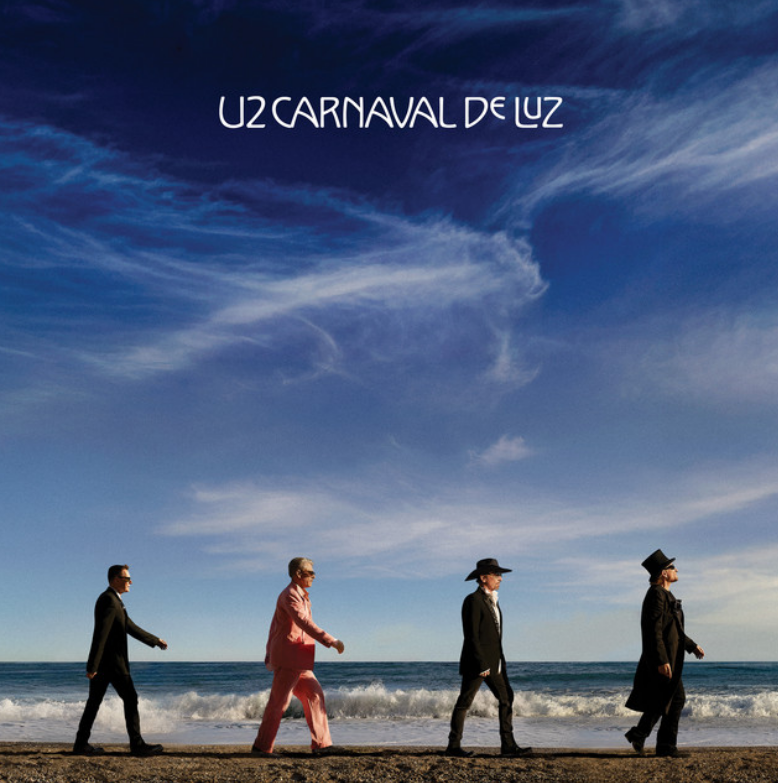
*Carnaval De Luz* will be released on November 13, coinciding with U2’s 50th anniversary. Twelve songs, Brian Eno, Jacknife Lee, Daniel Lanois, Martin Garrix, a mysterious reference to Rosalía, and a particularly emotional finale: “Torn,” Dolly Parton’s final vocal recording before her death.
Nine years.
For almost any band, that would feel like an eternity.
For U2, this might be exactly the time they need to have something to prove again.
Bono, The Edge, Adam Clayton, and Larry Mullen Jr. have just announced Carnaval De Luz, their first album of all-new material since *Songs of Experience*, released in 2017.
It will be U2’s sixteenth studio album.
It will be released on November 13, 2026, via Island Records.
And it features a song that will inevitably make the album more than just the comeback of one of the greatest rock bands on the planet.
Because the last song on *Carnaval De Luz* also features the last vocal performance Dolly Parton recorded before her death.
It’s called:
“Torn.”
And learning the story of how he ended up with U2 makes it even more exciting.
Dolly Parton got out of bed to record it
Bono wanted to work with Dolly Parton.
But the story didn’t begin with Carnaval De Luz.
The singer had contacted her about a side project related to Irish folk music. Dolly turned down that proposal.
Instead, he taught her a song he was working on.
“Torn.”
Bono resumed writing songs with Johnny McDaid, while Daniel Lanois, a key figure in U2’s history, ended up contributing pedal steel guitar to the recording.
But then Dolly Parton’s health took a turn for the worse.
And something happened that Bono still has a hard time hearing about.
The singer got out of bed to record her part.
“And you can hear that.”
That’s how Bono explained it to Rolling Stone. Producer Jacknife Lee also noted that Parton listened to and approved the finished mix and was proud of her performance.
Then he died.
He was 80 years old.
“Torn” ended up being his last recorded vocal performance.
And U2 decided to close the album with that song.
But *Carnaval De Luz* doesn’t seem like an album built around nostalgia
That’s important.
Because it would be incredibly easy to market U2’s comeback based solely on their history.
50 years.
Dublin.
The Joshua Tree.
Achtung Baby.
All That You Can’t Leave Behind.
Stadiums.
Decades of songs.
But the ” Carnaval De Luz ” performance points in exactly the opposite direction.
The Edge has described it as:
“A messy, provocative, sacred collection of songs.”
A chaotic, provocative, and sacred collection of songs.
And Bono doesn’t seem particularly interested in discretion either.
He talks about powerful guitars.
Deep bass.
Ecstatic rhythms.
Silver Tears.
Monsters.
Fire.
Darkness.
And songs that need to shine precisely because, outside of that “carnival of light,” the world can seem quite dark.
Pure Bonus.
But there’s something even more interesting beneath all that rhetoric.
U2 wants to sound dangerous again
Over the past few years, Bono has repeatedly expressed this idea.
The world doesn’t just need another U2 album.
He needs one that justifies his existence.
In previous conversations about the project, he went so far as to say that no one needed a new album from the band unless it was extraordinary, while The Edge hinted that what they were working on wouldn’t be just “a rock album.”
Now we can begin to understand what they meant.
The album was produced by Jacknife Lee and recorded in various locations during a creative process that also resulted in the EPs Days of Ash and Easter Lily , which were released as a surprise in early 2026.
Twelve songs.
Spirituality.
Friendship.
Freedom.
Resistance.
And a band trying to figure out what it means to still be U2 half a century after they started.
Exactly half a century
The timing of the announcement is no coincidence.
In September 1976, a teenager named Larry Mullen Jr. posted a handwritten notice on the bulletin board at Mount Temple Comprehensive School in north Dublin.
I was looking for musicians to start a band.
Several kids answered.
Among them:
Paul Hewson.
David Evans.
Adam Clayton.
Over time, the world would come to know them as:
Bono.
The Edge.
Adam Clayton.
Larry Mullen Jr.
Fifty years later, all four are still with U2.
And right during the week of their 50th anniversary, they announced the 16th album of their career.
It’s not a bad way to celebrate a golden wedding anniversary.
24 new songs in a single year
Here’s another fact that I think is amazing and that almost got lost amid all the headlines.
By the end of 2026, U2 will have released 24 new songs during their 50th anniversary.
That includes the previously released EPs and the twelve songs from *Carnaval De Luz*.
For a band whose last conventional collection of all-new material dates back to 2017, the contrast is striking.
After nine years of waiting for an album…
U2 has decided to release nearly two albums’ worth of songs in twelve months.
Why is it called ” Carnival of Light“?
Here’s a pretty nice idea.
The album is not conceptually separate from the two previous EPs.
Everything follows a sort of liturgical calendar.
Carnival is a celebration of the flesh—the flesh—before Lent.
Then comes the resignation.
Reflection.
And finally, the Easter resurrection.
Thus, *Carnaval De Luz * takes place conceptually before *Days of Ash * and *Easter Lily*.
Celebration.
Darkness.
Reflection.
Renaissance.
It’s not hard to find themes there that U2 has been exploring for decades.
It will be interesting to see if they’ve found a new way to count them this time.
“Silence” is 2 minutes and 35 seconds long
The first important sign is strange.
And pretty funny.
“Silencio” isn’t one of those monumental five-minute songs we automatically associate with U2.
Duration:
2:35.
The band itself describes it as a tribute to the defiance of early surf-punk.
Bono even dabbles briefly in Spanglish.
And the music video, directed by the Mexican-American duo Cliqua—Pasqual Gutiérrez and Raúl “RJ” Sanchez—was filmed in Mexico City and features U2 performing in a nearly empty ballroom.
But there is one important clarification.
“Silencio” isn’t actually the first song on the album that we hear
Although some international media reports have described it as the lead single, U2’s official website clarifies the chronology:
“Street of Dreams” was released in July.
“Silencio” is the second single from *Carnaval De Luz*.
It’s a small detail.
But if we want LoffMusic to become a reliable source, it’s worth telling the story correctly.
And that’s not the only piece of misinformation going around.
NO, Rosalía has not been confirmed as a guest artist
This is probably the item that generates the most searches in Spain.
The fourth track on the album is called:
“The Mirror Maker (Rosalía).”
At first glance, it seems obvious.
U2 featuring Rosalía.
And some media outlets interpreted it exactly that way.
But be careful.
The official list itself states:
The Mirror Maker (Rosalía)
whereas when Dolly Parton appears, she really makes an appearance:
“Torn” (feat. Dolly Parton).
The difference is significant.
In fact, Billboard initially reported that Rosalía appeared on the song and later corrected the information after a U2 spokesperson clarified the matter.
Therefore, as of now, the accurate information is:
There’s a U2 song called “The Mirror Maker (Rosalía),” but it hasn’t been confirmed whether Rosalía sings on it or appears in it.
And until U2 explains the meaning of the parentheses, I wouldn’t go any further.
That said:
We want to know why her name is Rosalía.
Brian Eno is also returning
There is another very important name.
Brian Eno.
One of the architects behind U2’s signature sound makes a comeback on *Carnaval De Luz*.
Eno is a co-writer and synthesizer player on:
“Go (Carnival of Light).”
“The Greatest Show on Earth.”
“Can’t Stop Us Now.”
And he’s not alone.
Martin Garrix co-wrote “Glorify.”
Ryan Tedder provides additional production on “Silencio.”
And Daniel Lanois plays pedal steel guitar on “Torn.”
In other words, U2 has brought together longtime collaborators with producers from later generations.
Another clue about the kind of album we can expect.
The 12 Songs of *Carnaval De Luz*
The official track list is as follows:
- Go (Carnival of Light)
- The Queen
- Street of Dreams
- The Mirror Maker (Rosalía)
- Superficiality
- If the World Is at War, We’d Better Not Be
- Silence
- The Greatest Show on Earth
- Glorify
- Midnight Sunshine
- Can’t Stop Us Now
- Torn (feat. Dolly Parton)
The titles alone contain enough clues.
Spanish.
War.
Mirrors.
Gloria.
Midnight Sun.
Rosalía.
And finally, Dolly Parton.
But there is one song that will inevitably stand out from all the others.
The final track on the album will also be Dolly Parton’s final track
After 11 songs, *Carnaval De Luz* will close with “Torn.”
A country song about broken family ties, written by U2, Dolly Parton, and Johnny McDaid.
And Dolly will be there.
Not like a voice retrieved from an archive.
Not like an old recording that’s been reused.
Not as a recreation using artificial intelligence.
As a performance he recorded for that song.
Her last one.
Bono admits that he can barely hear her now.
Millions of people will probably understand why when November 13 rolls around.
U2 is back after nine years—but also after fifty
It is difficult to distinguish between the two figures.
9.
The number of years since the last conventional album of new songs.
50.
The years since four teenagers started playing music together in Dublin.
In the middle:
More than 170 million albums sold, stadium tours, reinventions, excesses, activism, monumental albums, controversial albums, and some songs that have become part of the universal language of rock.
But Carnaval De Luz cannot survive on that story alone.
And U2 probably knows this better than anyone.
That’s why perhaps the truly important line Bono says in the entire commercial isn’t the one about the monsters.
Not even the one about fire.
Not even the one with the guitars.
It’s this idea:
If the world is in darkness, we shouldn’t be.
U2 has been trying for fifty years to turn thoughts like these into epic songs.
On November 13, we’ll find out if he still knows how to do it.
But when the album’s final song comes around, the story will inevitably shift to a new protagonist.
A guitar will play.
Bono will appear.
And then we’ll hear a voice that the world will never hear again as we record a new song.
Dolly Parton.
One last time.