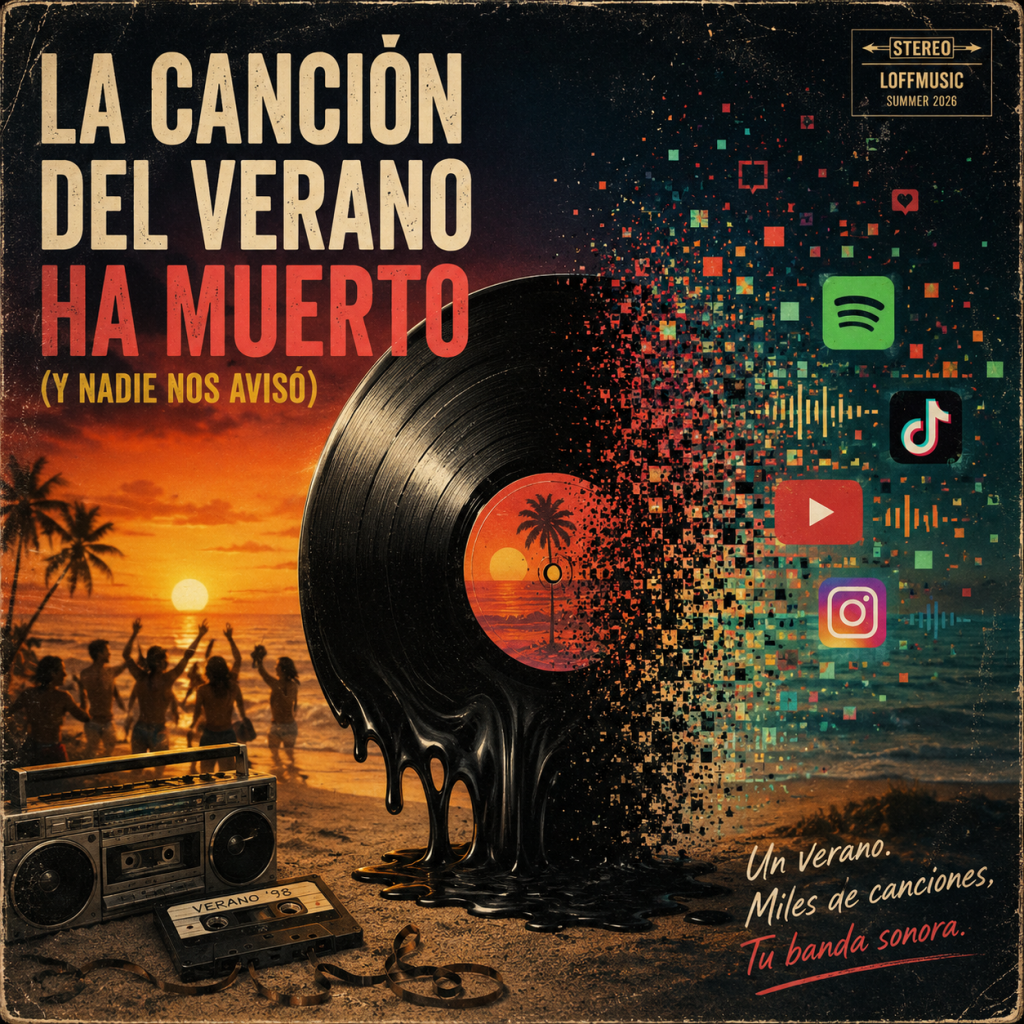
For decades, a single hit was enough to bring an entire country together. Today, everyone experiences their own musical summer. What happened? Who killed the summer song? And, above all, have we come out ahead?
There are sounds that are part of our collective memory.
It doesn’t take more than three seconds of listening to know exactly where we were when we first heard them.
“Macarena.“
“Aserejé.“
“Bomb.“
“Despacito.“
“La Gozadera.“
They weren’t just songs.
They were cultural events.
For a few months, they managed to achieve something that seems impossible today: getting a teenager, a taxi driver, a family in Benidorm, a DJ in Ibiza, and a waiter at a beach bar to listen to exactly the same music.
“Song of the Summer” wasn’t just a label.
It was a common language.
But one day he disappeared.
And the funny thing is, we hardly even noticed.
When we were all listening to the same thing
Until relatively recently, discovering music was easy.
There were few entry points.
The radio.
Music television shows.
The compilations that came out every June.
The albums that played in the cars during the holidays.
The bars.
The town’s festivals.
It was a limited ecosystem.
That led to something extraordinary.
The entire country was listening to practically the same soundtrack.
If a song was a hit, it was a hit for everyone.
There were no bubbles.
There were no algorithms.
There were no personalized playlists.
Music was still a collective space.
Then came the algorithms
Today, when we open Spotify, each user sees a different cover image.
TikTok suggests different songs depending on how we interact with the app.
Instagram makes a 15-second clip go viral.
YouTube recommends different videos even within the same household.
Apple Music.
Amazon Music.
Shazam.
Every platform listens for us even before we press the play button.
Before we knew it, we stopped sharing songs.
We started sharing algorithms.
And that’s when the summer hit began to fade away.
There are now thousands of different summers
Maybe this summer you’ll be listening to Olivia Rodrigo nonstop.
Your best friend is featured on Justice’s new album.
Your brother is hooked on “Barry Can’t Swim.”
Your parents are still playing the Rolling Stones.
And under the umbrella next to us, someone is dancing to Bad Bunny’s latest hit.
The funny thing is that you’re all right.
Because everyone experiences summer differently.
We’ve never had so much freedom to listen to music.
We had never been so far apart musically.
TikTok no longer creates classics
There is another change that is even more significant.
Back then, a song could last an entire summer.
Even several years.
These days, many go viral right from the start…
…and they disappear two weeks later.
The algorithm needs constant updates.
It does not reward loyalty.
It rewards speed.
The consequence is obvious.
We’re seeing more and more viral songs.
And even fewer unforgettable songs.
Festivals have created another parallel reality
There’s one detail that many people overlook.
Festivals no longer mean the same thing as Spotify playlists.
This summer, thousands of people have sung along to Barry Can’t Swim, Justice, FKA twigs, Turnstile, and Empire of the Sun.
However, many of those names barely appear on the most popular lists.
And with some of the biggest streaming hits, the exact opposite is true.
We experienced two completely different musical conversations.
The digital one.
And the in-person one.
Radio Lost Its Monopoly
For decades, the radio decided which songs would be hits.
Today, just join the conversation.
Radio stations no longer create hits.
They’re being chased.
TikTok is picking up speed.
Spotify confirms.
YouTube amplifies.
The radio comes later.
It is one of the biggest changes the music industry has seen since the advent of the MP3.
The summer of 2026 doesn’t have a soundtrack.
He has a lot of them.
Some people will remember this summer for Olivia Rodrigo’s “The Cure. “
Others because of the electronic sensation created by Justice and Angèle.
Many people won’t be able to stop listening to *Barry Can’t Swim*.
Pop music fans will be torn between Charli XCX and Lola Young.
Rock fans will celebrate the return of Editors or the Rolling Stones.
Meanwhile, Bad Bunny will continue to take Latin American beaches by storm, and DJs will fill Ibiza with Afro house, melodic techno, and organic electronic music.
Never before had a summer sounded so different depending on who was listening.
Maybe the song of the summer will never come back
And maybe it won’t be necessary.
For years, we viewed music as a mass phenomenon.
Today, it serves as a reflection of our personality.
Listening to a song is no longer just about enjoying it.
It’s also a way of shaping who we are.
That explains why two people are vacationing together…
…and don’t share a single song.
What We’ve Lost
We’ve lost those moments when everyone knew the same chorus.
Weddings.
Folk festivals.
Impromptu karaoke sessions.
The feeling of being part of a huge musical conversation.
That hardly exists anymore.
What We’ve Achieved
But we’ve also gained something wonderful.
Diversity.
It has never been easier to discover artists.
Never before had so many styles coexisted.
An independent band could never compete on equal footing with a global superstar.
Music no longer depends solely on a record label’s budget.
It depends, above all, on the ability to move people.
And that’s great news.
LoffMusic’s opinion
Perhaps the biggest mistake is to keep asking ourselves what the song of the summer will be.
The real question should be a different one.
What was your song of the summer?
Because it probably doesn’t match mine.
And that, far from being a problem, shows that we are living in the freest era in the history of music.
The “song of the summer” may be a thing of the past.
But in return, each of us has gained the opportunity to write our own soundtrack.
And perhaps that is the greatest musical revolution of the 21st century.