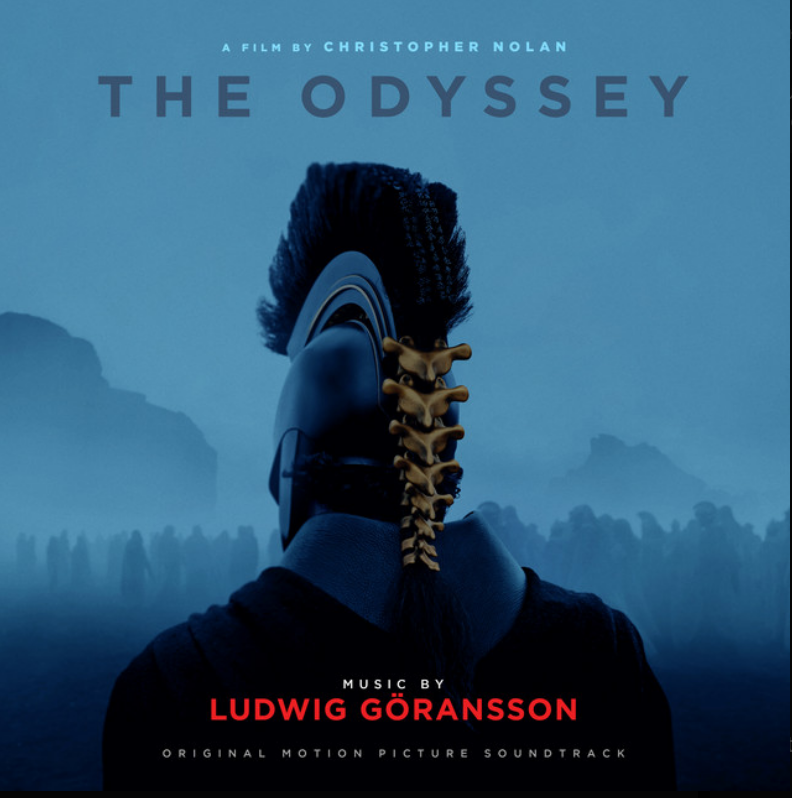
When Christopher Nolan releases a movie, the anticipation isn’t limited to the visuals. It also extends to the music. From *Interstellar* to *Oppenheimer*, his soundtracks have been an essential part of the cinematic experience, and with *The Odyssey*, he once again demonstrates that he views sound as a narrative tool just as important as the screenplay or cinematography.
For this adaptation of Homer’s immortal poem, Nolan has once again turned to Ludwig Göransson, the Oscar-winning composer of *Oppenheimer* and creator of some of the most original scores in recent cinema. However, the challenge this time was entirely different: to create the soundscape of a world that existed more than three thousand years ago without falling into the clichés of epic cinema.
The result is a surprising, atmospheric soundtrack that is profoundly different from any other production set in Ancient Greece.
A soundtrack that breaks with tradition
Movies like *Gladiator*, *Troy*, and *Ben-Hur* have led viewers to associate epic stories with large orchestras, majestic choirs, and heroic melodies. Christopher Nolan wanted to break away from that tradition.
According to various reports about the production, the director asked Ludwig Göransson to avoid building the music around a conventional symphony orchestra and to seek a sonic identity inspired by the instruments and textures that might evoke Bronze Age Greece.
Rather than faithfully recreating ancient music—which is impossible due to the scarcity of sources—the intention was to create a believable soundscape to accompany Odysseus’s long journey from Troy to Ithaca.
Antique Instruments for a Legendary Journey
To achieve that unique sound, Göransson worked with a team of specialists in early music and ethnomusicology. The recording features instruments rarely heard in a Hollywood blockbuster, such as the Greek lyre, the aulos (an ancient wind instrument), large bronze gongs, and various traditional vocal techniques. Part of the recording also featured performances of isopolyphonic chants from the Balkan Mediterranean, adding a truly unique texture to the whole piece.
The result does not seek to sound “historic” in the strict sense, but rather to transport the viewer to an ancient, mysterious, and deeply human world.
Music that Accompanies Odysseus’ Journey
The soundtrack accompanies the hero’s journey from an emotional perspective. It doesn’t rely constantly on grand, heroic themes, but rather on atmospheres that evolve alongside the protagonist.
Songs like “Ithaca, ” “Penelope, ” and “Let’s Go Home” convey a sense of homesickness, while pieces like “Cyclops, ” “Sirens, ” and “Hades” introduce dark, tense textures that reflect the dangers of the journey. The album culminates with “Odysseus” and “The Trial of the Bow / Vengeance, ” two of the most intense compositions on the score.
More than just a collection of memorable melodies, Göransson creates a soundscape that serves as a unifying thread throughout the film.
Complete list of songs from the soundtrack
The official album, released by Back Lot Music, includes 23 original tracks:
- Zeus’s Law
- Ithaca
- Penelope
- Telemachus
- Calypso / Agamemnon
- Let’s Go Home
- Cyclops
- Menelaus, Husband of Helen
- Troy
- Laestrygonians
- Circe (feat. Samantha Morton)
- Hades
- Loyal to the Future
- Sirens
- Apollo’s Island
- 7 Years
- Another Name
- Bringing It All
- Welcome Home, Stranger
- Odysseus
- The Trial of the Bow / Vengeance
- Chasing the Setting Sun
- “When I’m Home ” – James Blake, Travis Scott, and Ludwig Göransson.
“When I’m Home,” the surprise in the end credits
Although the album is dominated by instrumental music, the final track is an exception. “When I’m Home” brings together Ludwig Göransson, James Blake, and Travis Scott on a song co-written with Christopher Nolan himself to accompany the end credits.
The collaboration has drawn particular attention because Travis Scott also makes a brief appearance in the film playing a bard—a nod to the oral tradition through which Homer’s poem was passed down for centuries.
One of Ludwig Göransson’s most daring works
It would be a mistake to compare this soundtrack to *Oppenheimer*, *Tenet*, or *Black Panther *. Here, Göransson forgoes grand orchestral swells in favor of a much more restrained, experimental, and atmospheric approach.
That is precisely where its greatest strength lies. Instead of repeating formulas that already work, the composer once again demonstrates that every story needs to find its own sound. And that makes *La Odisea* one of the most personal scores of his career.
It may not be the most accessible soundtrack or the easiest to listen to outside of the movie, but it is one of the most daring and cohesive soundtracks to come out of commercial cinema in recent years.
Where to Listen to the Soundtrack for *The Odyssey*
The original soundtrack is now available on platforms such as Spotify, Apple Music, Amazon Music, and YouTube Music. In addition to the digital release, Back Lot Music has confirmed CD and vinyl releases for collectors.
Our Opinion
With *The Odyssey*, Ludwig Göransson proves that he is not merely a composer who illustrates images: he creates soundscapes. His collaboration with Christopher Nolan enters a new phase with a score that dares to challenge the conventions of epic cinema and forge its own identity.
You won’t find here the grandiloquence of other films set in antiquity. You’ll find something harder to come by: music that seems to spring from Odysseus’s own journey and that accompanies every stage of his return to Ithaca with character, daring, and extraordinary sensitivity.