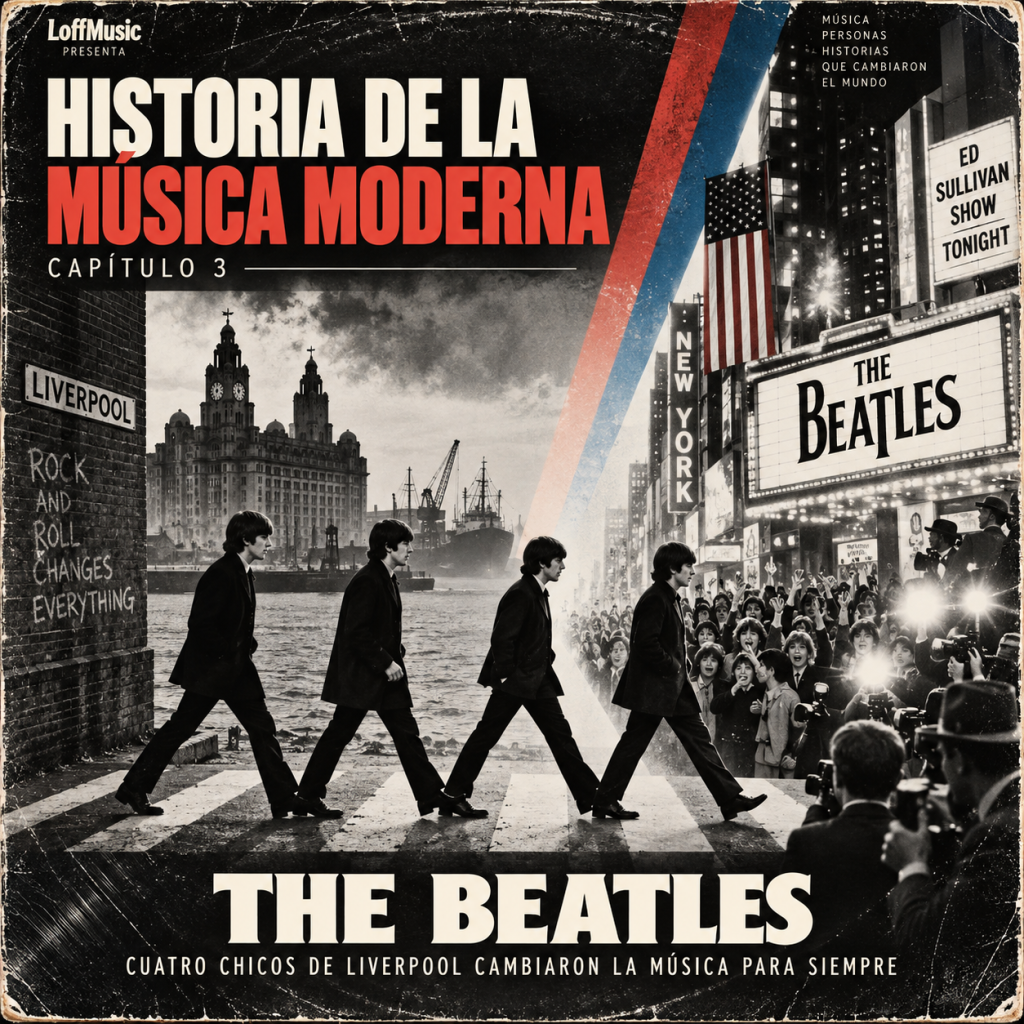
The United States had invented rock and roll. But just when it seemed the revolution was beginning to run out of steam, four young Englishmen brought that music back to the country where it was born. Their names were John, Paul, George, and Ringo. After them, a band was never just a band again.
Rock and roll seemed indestructible.
Until, all of a sudden, it began to run out of heroes.
Buddy Holly died.
Elvis Presley joined the army.
Little Richard found God.
Chuck Berry had run-ins with the law.
Jerry Lee Lewis was tarnished by the scandal.
Eddie Cochran died in an accident.
In the late 1950s, the music that had terrified parents, teachers, and politicians seemed to be losing its edge.
The industry had survived the revolution.
He had learned how to sell it.
And then something happened that almost no one expected.
The next revolution did not come from the United States.
He came from a port city in northern England.
Liverpool.
And it all began with four young men who were obsessed with precisely that American music that seemed to be disappearing.
Liverpool was listening to América
To understand The Beatles, you first have to understand where they grew up.
Liverpool was a port city.
It wasn’t just goods that came through its docks.
Records were coming in.
Blues.
Rhythm & blues.
Rock and roll.
Country.
Soul.
Young Britons could discover music from the United States there that wasn’t always easy to find in other parts of the country.
And John Lennon was one of those young people.
In 1956, he formed a skiffle group called The Quarrymen.
A year later, she met Paul McCartney.
Paul knew how to play.
But there was something even more important.
He knew some songs.
Shortly afterward, an even younger guitarist appeared.
George Harrison.
He was only 15 when he started playing with them.
The Beatles didn’t exist yet.
But three of them were already there.
Before they took over the world, they had to survive in Hamburg
Mythology often begins in Liverpool.
But musically, The Beatles came of age elsewhere.
Hamburg.
In the early 1960s, they traveled to Germany to play in clubs in the St. Pauli neighborhood.
The conditions were brutal.
Endless performances.
Whole nights.
Challenging Audiences.
Alcohol.
Fatigue.
Rock and roll.
The repertoire had to last for hours, so they learned hundreds of songs.
Chuck Berry.
Little Richard.
Carl Perkins.
Buddy Holly.
Elvis.
The Coasters.
Motown.
Rhythm & blues.
The Beatles didn’t learn about rock by reading about it.
They learned it by playing it for hours in front of people who could stop listening at any moment.
By the time they returned to Liverpool, they were a different band.
The Beatles’ official website notes that they would go on to perform about 292 times at The Cavern Club between 1961 and 1963.
The stage had become his school.
A man walked into The Cavern and saw something that the others couldn’t see yet
On November 9, 1961, another one of those small events took place that later seem inevitable.
Brian Epstein walked into The Cavern.
Epstein ran a record store.
He wasn’t a musician.
I had never before discovered a band that was destined to change the world.
But he saw something.
John.
Paul.
George.
A loud band.
Fun.
Magnetic.
Still a little wild.
And he decided to become their manager. The band’s official chronology dates that first meeting to November 1961.
Epstein began to transform the group’s stage presence.
More discipline.
Better image.
Suits.
Professionalism.
But they needed something much more difficult.
A record deal.
And the companies didn’t seem particularly interested.
“Guitar bands are a thing of the past”
The phrase has become one of the great legends of the music industry.
Decca turned down The Beatles after an audition held on January 1, 1962.
The story is often summed up by that supposed claim that guitar bands were “on their way out.”
Whatever the exact wording used at the time, what really matters is what happened afterward.
Decca said no.
Others didn’t see the future either.
Until George Martin came along.
The fifth Beatle didn’t know it yet
George Martin worked for Parlophone, a label owned by EMI.
He had produced comedy, classical music, and various recordings outside the realm of rock.
On paper, he didn’t seem like the man destined to form the most important rock band of the century.
But he heard something.
On June 6, 1962, The Beatles recorded a session for Parlophone at EMI Studios on Abbey Road.
George Harrison would later recall that Martin still found them “raw and rough,” but sensed something interesting about them.
That was the beginning of one of the most significant relationships in the history of popular music.
The Beatles had songs.
George Martin knew how to turn ideas into albums.
And then Ringo arrived
There was still one piece missing.
Drummer Pete Best left the band.
In August 1962, Ringo Starr joined the band.
John Lennon.
Paul McCartney.
George Harrison.
Ringo Starr.
At last, all four of them were there.
And just a few weeks later, the first album was released.
It all started with a harmonica
On October 5, 1962, Parlophone released:
“Love Me Do”.
It didn’t seem like the beginning of a revolution.
It was a simple song.
A little over two minutes.
A harmonica.
Two voices.
A primal rhythm.
An almost childlike declaration of love.
But there was one crucial thing.
They had written it.
John Lennon and Paul McCartney.
Nowadays, it seems normal for a band to write its own songs.
So it wasn’t that big of a deal.
Many performers depended on professional composers.
The Beatles were going to change that, too.
“Love Me Do” reached No. 17 in the United Kingdom. The official discography confirms that it was their first British single and that it was released on October 5, 1962.
They didn’t take over the world that week.
But they had come in through the door.
Lennon and McCartney had just invented a song-making machine
John Lennon and Paul McCartney had begun writing songs together long before they became famous.
And they worked out an extraordinarily simple agreement.
The songs they wrote—whether together or individually—would bear the signature:
Lennon–McCartney.
But what was truly revolutionary wasn’t credit.
It was the speed.
“Please Please Me”.
“From Me to You.”
“She Loves You.”
“I Want to Hold Your Hand.”
One song after another.
Instantly recognizable melodies.
Vocal harmonies.
Choruses.
Energy.
And an almost instinctive understanding of how long a pop song should be before the listener would want to hear it again.
The Beatles didn’t invent rock and roll.
They had learned from Chuck Berry, Little Richard, Buddy Holly, Elvis, Carl Perkins, and African American music.
But they were beginning to turn all of that into something else.
An album recorded practically in a single day
On February 11, 1963, The Beatles entered EMI Studios in London.
They needed to record their first album.
They did it almost all at once.
The band’s official chronology confirms that ten songs from *Please Please Me* were recorded that same day.
There were no months of study.
Not even hundreds of clues.
Not even computers.
The intention was to capture, more or less, what happened when The Beatles took the stage.
In the end, they saved “Twist and Shout” for last.
John Lennon’s throat was in terrible shape.
They knew they would have practically only one chance to try.
He did it.
And that raspy voice we hear on the album isn’t a production effect.
He’s a singer pushing himself to the limit.
Please Please Me was released on March 22, 1963.
In May, it reached number one on the British charts.
He stayed there for 30 weeks.
Until another album replaced it.
Whose?
By The Beatles.
With The Beatles.
Beatlemania had begun.
And suddenly the girls started screaming
There are moments in The Beatles’ recordings when it’s almost hard to hear the music.
Because the crowd is cheering.
He doesn’t clap.
Yell.
Thousands of teenagers discovered something that seems obvious to us today but was much more unsettling back then:
They could have their own idols.
Their own tastes.
Their own money.
Their own culture.
And they were able to express it.
Beatlemania was not just a musical phenomenon.
It was a social phenomenon.
The Beatles had bangs.
Humor.
Liverpool accent.
They didn’t look like stars made by adults.
They seemed to belong to the young people.
And that was extraordinarily powerful.
But there was a problem: the United States wasn’t interested
The United Kingdom had already surrendered.
Europe was beginning to do so.
But to truly become the world’s biggest band, they still had to conquer the country that had invented the music they loved.
United States.
At first, U.S. record labels didn’t seem to know what to do with them.
That changed with:
“I Want to Hold Your Hand.”
On January 25, 1964, the song reached number one on the U.S. charts.
And two weeks later, something happened that changed the course of popular culture.
February 9, 1964, 8:00 p.m.
An American family turns on the TV.
Then another one.
And another one.
And another one.
Until you reach approximately:
73 million people.
The Beatles appear on The Ed Sullivan Show.
John.
Paul.
George.
Ringo.
Four young people from Liverpool performing in front of an audience representing a huge portion of the country.
The program recorded the following viewership figures: 73 million viewers, approximately 60% of the televisions that were turned on that night.
Ed Sullivan delivers an introduction that would go down in history.
And it begins:
“All My Loving.”
The shouting almost drowned out the song.
Then they perform “Till There Was You.”
“She Loves You.”
Later:
“I Saw Her Standing There.”
And finally:
“I Want to Hold Your Hand.”
In less than an hour, the United States realized that something had changed.
The country was still mourning Kennedy
There is a context that makes that night even more powerful.
Only 77 days had passed since the assassination of John F. Kennedy.
The United States continued to experience one of the most traumatic periods in its recent history.
And suddenly, four English boys showed up.
Fun.
Irreverent.
Noisy.
With songs you just can’t get out of your head.
Of course, that alone doesn’t explain Beatlemania.
But it helps explain why that outburst of collective joy came at such a particularly sensitive time. The archives of *The Ed Sullivan Show* also explicitly highlight that context. (*The Ed Sullivan Show*)
America invented rock. England gave it back, transformed.
And then the perfect irony unfolded.
For years, young Britons had been listening to American music.
Chuck Berry.
Muddy Waters.
Little Richard.
Buddy Holly.
Elvis Presley.
Bo Diddley.
The Everly Brothers.
Now the United States was beginning to listen to British bands that had learned from those same artists.
After The Beatles came:
The Rolling Stones.
The Animals.
The Kinks.
The Who.
The Dave Clark Five.
Gerry and the Pacemakers.
Herman’s Hermits.
History has dubbed him:
The British Invasion.
The Ed Sullivan Show’s own archives cite February 9, 1964, as the symbolic beginning of that invasion and list the wave of British artists who subsequently crossed the Atlantic.
But there was something even more important.
All of a sudden, everyone wanted to start a band
This may be The Beatles’ most profound early legacy.
Elvis had inspired thousands of young people to want to be like him.
The Beatles made thousands of people want to find three more friends.
Guitar.
Low.
Battery.
Voices.
A band.
And there was another difference as well.
They were composing.
They were playing.
They had different personalities.
John could be the sarcastic one.
Paul, the Melodic One.
George, the reserved one.
Ringo, the funny one.
The audience could choose their favorite Beatle.
Without realizing it, they were creating much of the musical style that pop bands would go on to use for decades.
But they still hadn’t done the truly incredible thing
We could end the story right here.
Four boys from Liverpool are taking the world by storm.
Happy ending.
But then we would miss out on what is truly extraordinary.
Because in 1964, The Beatles were arguably the biggest pop group on the planet.
They could have just stuck to the same formula.
Three-minute songs.
Movies.
Concerts.
Girls screaming.
Albums.
Millions.
But they didn’t.
They began to wonder:
What else could a pop song be?
And that question was going to change everything all over again.
Bob Dylan and marijuana would arrive.
Indian music.
Tapes played in reverse.
Studios turned into instruments.
Rubber Soul.
Revolver.
“Tomorrow Never Knows.”
And finally, an album that made people think an album could be more than just a collection of songs:
Sgt. Pepper’s Lonely Hearts Club Band .
But that’s another story.
Because before turning the recording studio into a lab…
The Beatles had to conquer the world.
And it had all started with something extraordinarily small.
Four young people.
Three chords.
A harmonica.
And a song called:
“Love Me Do”.